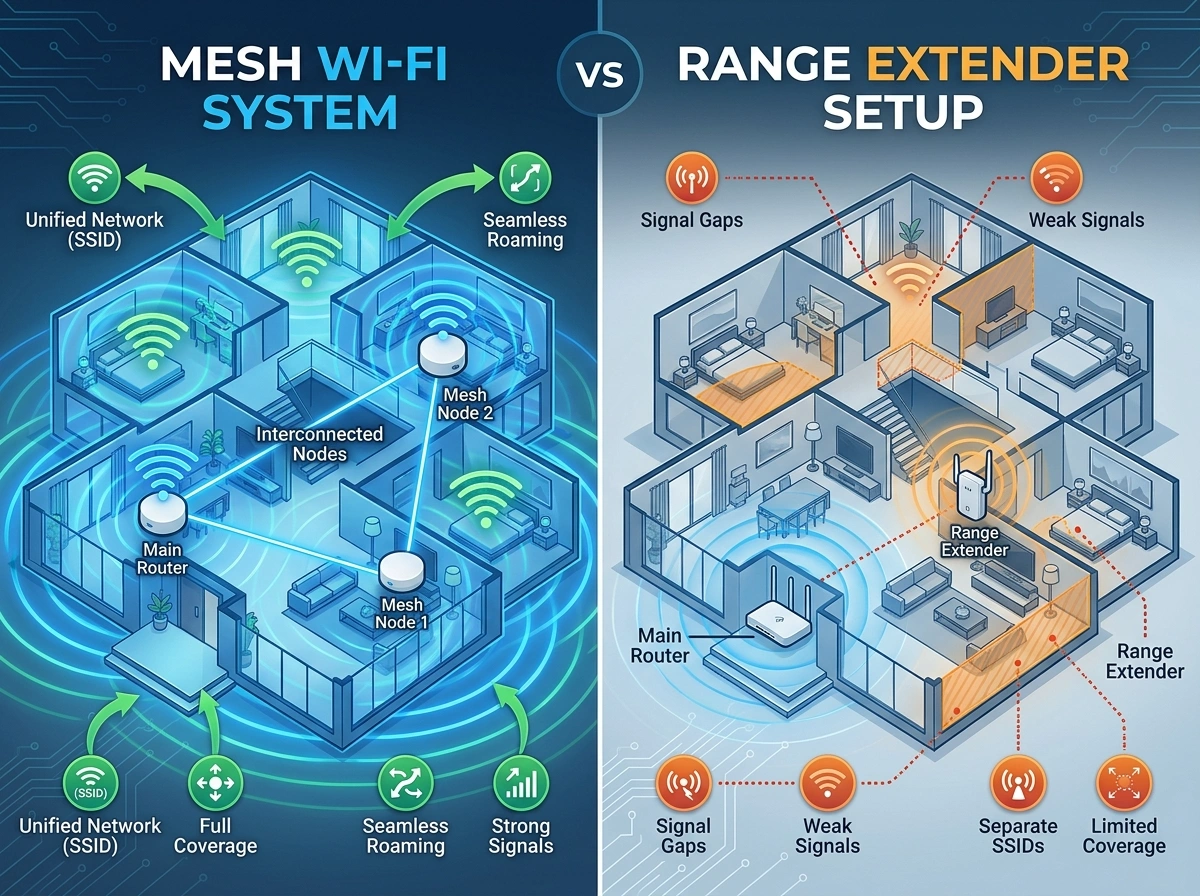
Dead zones in a large home can turn a simple video call into a frustrating mess. If your Wi-Fi fades the moment you walk upstairs or step into the back bedroom, you are not alone. Plenty of homeowners across the country struggle with patchy coverage in big houses, sprawling ranch-style layouts, and multi-story homes.
Two popular solutions promise to fix the problem: mesh Wi-Fi systems and range extenders. Both expand your wireless network, but they work in very different ways. The team at teck-jb.com breaks down how each one performs so you can make a smart choice for your space and budget.
What Is a Mesh Wi-Fi System?
A mesh Wi-Fi system uses several devices, often called nodes, that work together to blanket your home in a single, unified network. You place a main node near your modem, then spread additional nodes throughout the house. Each node talks to the others, creating a web of coverage that hands your devices off smoothly as you move around.
The big advantage here is the single network name. Your phone, laptop, and smart devices stay connected to one Wi-Fi network no matter where you go. There is no manual switching, no dropped connections, and no fiddling with separate networks for each floor.
Mesh systems also tend to be smart. Many use dedicated bands to communicate between nodes, which keeps speeds high even as data travels across the house. Popular options from brands like Eero, Google Nest, and Netgear Orbi have made these systems a favorite for tech-forward households.
What Is a Range Extender?
A range extender, sometimes called a Wi-Fi repeater or booster, does exactly what the name suggests. It grabs your existing Wi-Fi signal and rebroadcasts it to reach further into your home. You plug it into an outlet roughly halfway between your router and the dead zone you want to fix.
Extenders are affordable and simple. For many people, a single extender solves a single problem, like weak signal in a home office or a basement gym. They are a quick, low-cost fix that does not require replacing your existing router.
The catch is that traditional extenders often create a separate network name. You might see “HomeWiFi” and “HomeWiFi_EXT” on your device list, forcing you to switch manually between them. They can also cut your bandwidth, since the extender uses the same band to receive and resend the signal.
How Each Solution Works in a Large Home
In a big home, the difference between these two technologies becomes obvious.
A mesh system spreads multiple nodes across your floor plan, so coverage stays strong from the front porch to the far corner of the backyard. Because the nodes coordinate, your connection rarely drops as you move from room to room.
A range extender, on the other hand, pushes your existing signal outward from one or two points. This works well for filling a specific gap, but it struggles to cover a sprawling layout evenly. Stack too many extenders and you risk a tangled network with inconsistent speeds.
Detailed Comparison: Mesh Wi-Fi vs. Range Extenders
Here is a side-by-side look at how the two stack up across the factors that matter most for large homes.
|
Factor |
Mesh Wi-Fi |
Range Extender |
|---|---|---|
|
Coverage |
Whole-home, seamless |
Targeted gaps only |
|
Network name |
Single unified network |
Often separate networks |
|
Speed |
Consistent throughout |
Can drop near the extender |
|
Setup |
App-guided, easy |
Quick but more manual |
|
Scalability |
Add nodes anytime |
Limited, gets messy fast |
|
Cost |
Higher upfront |
Budget-friendly |
|
Best for |
Big, multi-story homes |
Small dead zones |
Coverage and Performance
Mesh systems win on coverage for large spaces. The nodes work as a team, so you get steady speeds whether you are streaming in the living room or working in a detached garage office. Range extenders boost a single trouble spot well, but they cannot match a mesh network’s even, whole-home performance.
Cost
Range extenders are the clear budget choice. A solid extender can cost as little as $30 to $60. Mesh systems usually start around $150 and climb higher for premium multi-node kits. The right pick depends on whether you need to patch one weak spot or upgrade your entire home.
Ease of Setup
Both options are designed for everyday users. Mesh systems shine with guided mobile apps that walk you through placement step by step. Extenders set up quickly too, though connecting them to the right band and finding the ideal outlet can take a little trial and error.
Scalability
This is where mesh truly pulls ahead. Need more coverage? Just add another node and it joins the network automatically. Range extenders do not scale gracefully. Adding a second or third extender often creates more headaches than it solves.
Pros and Cons
Mesh Wi-Fi
Pros
- Seamless whole-home coverage
- Single network name, no manual switching
- Easy to expand with extra nodes
- Smart features and app control
Cons
- Higher upfront cost
- May be overkill for small homes
Range Extenders
Pros
- Affordable and widely available
- Quick fix for a single dead zone
- No need to replace your router
Cons
- Often creates separate networks
- Can reduce speed
- Poor scalability for big homes
Our Recommendation for Big Home Owners
For most large homes, a mesh Wi-Fi system is the better long-term investment. The seamless coverage, single network, and easy scalability make it ideal for multi-story houses, open floor plans, and homes with detached spaces. You get reliable speed in every room without juggling network names or chasing dead zones.
A range extender still has its place. If your house is mostly well-covered and you only fight a single weak spot, an extender offers a fast, wallet-friendly fix. It is also a smart stopgap if you are not ready to upgrade your whole setup just yet.
When weighing your decision, think about your home’s size, your daily internet habits, and your budget. A family that streams, games, and works from home across several floors will feel the benefits of mesh right away. A renter in a smaller space might be perfectly happy with a single extender.
Conclusion
Choosing between mesh Wi-Fi and a range extender comes down to your home and your needs. Mesh systems deliver smooth, scalable, whole-home coverage that is hard to beat in large houses. Range extenders offer a budget-friendly way to fix a specific dead zone without a full upgrade.
For sprawling, multi-story homes, mesh is usually the winner. For a single weak spot, an extender gets the job done. Either way, the right setup means strong, reliable Wi-Fi in every corner of your home, so you can stream, work, and connect without interruption.